
The Issue
Atmospheric rivers, long and narrow bands of intense water vapor in the lower atmosphere, often bring extreme rainfall to Southeast Alaska, increase landslide risk, and elevate public safety concerns. The NSF-funded Ḵutí team works to reduce this risk through collaboration among scientists, Tribal environmental staff, Culture-bearers/Traditional knowledge holders, broader community, youth groups, and educators across partner communities. The following work focuses on Prince of Wales Island communities.
The Result
This study developed a four-step community science protocol to assess geohazard risk on Prince of Wales Island. This approach combines community meetings, field measurements, youth engagement, and tool development. Outcomes include improved understanding of local landslide concerns, community-driven data collection, and workforce development through youth programs. Results are informing a geohazard dashboard integrating community perspectives, rainfall thresholds, landslide modeling, and atmospheric river impacts.
PROJECT OVERVIEW
Landslides affect all communities on Prince of Wales Island, causing road closures, power outages, and threats to lives, houses, and infrastructure. These events are often triggered by atmospheric rivers, long and narrow corridors of intense water vapor that bring extreme rainfall and strong winds over several days.
To improve community safety in landslide-prone areas, we developed a four-step protocol. First, we engaged community members through meetings, workshops, and potlucks to identify shared concerns, strengthen emergency planning, and explore connections among landslides, land use, infrastructure (e.g., bridges and culverts), and salmon habitats. Second, we enhanced understanding of storm conditions that trigger landslides by collecting hydrologic data, including rainfall measurements across elevation gradients. Results show rainfall is often greatest along mountain slopes around 350 m in elevation near landslide initiation sites.
Third, we supported education and workforce development by partnering with the Alaska Youth Stewards program. High school students learned to identify landslide-prone terrain, assess management impacts, collect field data, install monitoring equipment, evaluate landslide runout models, and contribute to the community by planting culturally significant cedar seedlings.
Finally, we are developing community tools, including action plans, hazard maps, and a geohazard dashboard. These tools integrate local rainfall thresholds and landslide modeling to help communities better assess and prepare for local landslide risk.
What was/were the target goal(s) of this project?
The project aimed to enhance community resilience in landslide-prone areas of Southeast Alaska. We improved understanding of rainfall amounts and variability associated with atmospheric rivers and topographic influences. These insights support better weather forecasting and will inform a geohazard dashboard tool to assess landslide risk. Our four-step protocol can be applied locally and elsewhere to engage, evaluate, and address community priorities.
COMMUNITY
Community Involvement and Influence
Tribal direction and community involvement were central to the study. Local knowledge shaped research priorities, guided site selection for rain gauges, and supported installation and maintenance of equipment contributing data to the NOAA National Weather Service Juneau Forecast Office. Community partners assisted with logistics, while local youth participated in fieldwork, education, and outreach. Community input also informed tool development and improved understanding of storm and landslide impacts.
Benefits for the Local Community
Tribal direction and community involvement were central to the study. Local knowledge shaped research priorities, guided site selection for rain gauges, and supported installation and maintenance of equipment contributing data to the NOAA National Weather Service Juneau Forecast Office. Community partners assisted with logistics, while local youth participated in fieldwork, education, and outreach. Community input also informed tool development and improved understanding of storm and landslide impacts.
Future Plans for the Project
In the final year of this five-year Ḵutí project, next steps include launching a hazard dashboard prototype in the summer 2026, along with continued community meetings, youth engagement, and publication of landslide modelling, rainfall, and atmospheric river analyses. Ongoing evaluation of over 100 storms will further assess topographic influences on rainfall and link storms to atmospheric river characteristics, such as direction, speed, temperature, and water vapor intensity.
OUR REFLECTIONS
Community science moves at the speed of trust. Our iterative and interactive four-step engagement process includes community meetings and potlucks, hydrologic measurements, youth engagement, and tool development, fostering communication and meaningful collaboration. We also participated in culture camps and attended community meetings beyond landslide topics to build relationships. These sustained engagements strengthened local networks and enthusiasm. For example, a community idea led Alaska Youth Stewards to distribute informational magnets to residents along a landslide-prone road, increasing awareness and meeting participation. The Alaska Youth Stewards also created a board game, “Evacuation,” to share geohazard knowledge at a regional Tribal environmental conference. Over time, these connections enhanced knowledge sharing and inspired further landslide-related inquiry.
Anything else you would like to share that could assist others looking to organize their own projects in the future?
Taking time to build relationships and engage with communities strengthens both science and outcomes. Incorporating local and Traditional knowledge improves understanding of environmental challenges and can reveal new directions for community-centered research.
Johnson, A., et al. (2025), Participatory Science for Landslide Community Awareness: Development of a Protocol for Southeast Alaska, Community Science Exchange, https://doi.org/10.1029/2025CSE000103. Published 17 October 2025.
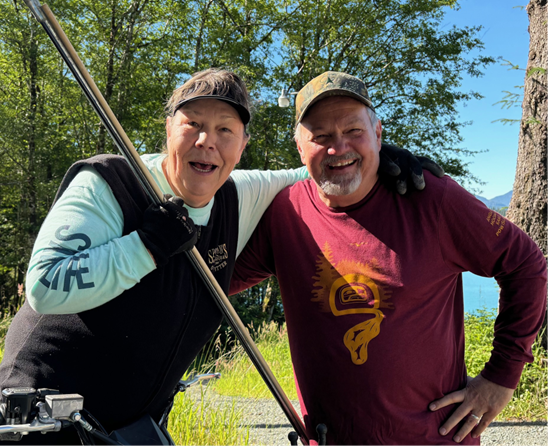
Community leaders, Deborah Head and Robert Girt.
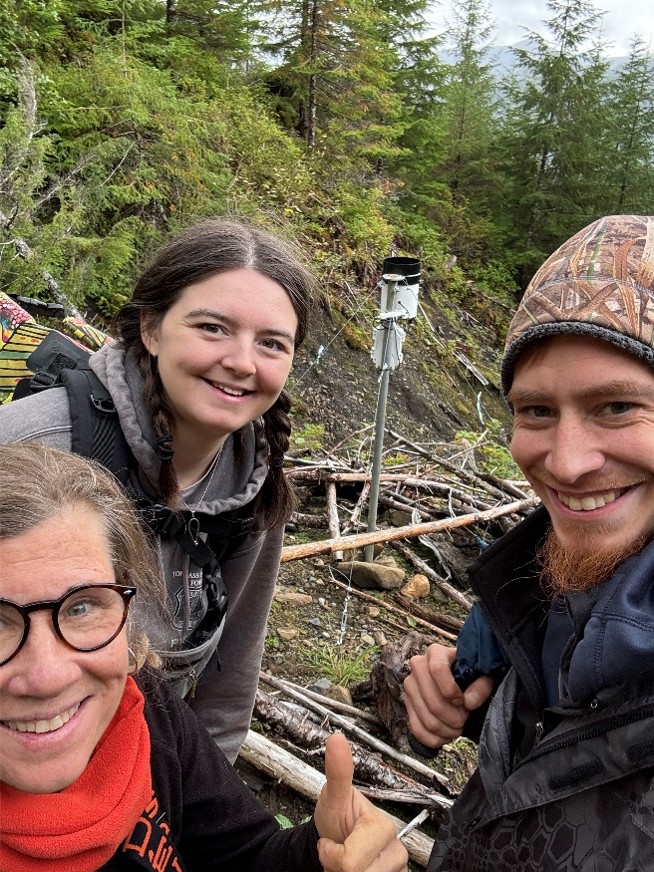
Rain Gauge Maintenance on Sunnahae Mountain with Adelaide Johnson, Skylar O’Neil, and Jess Isaacs.
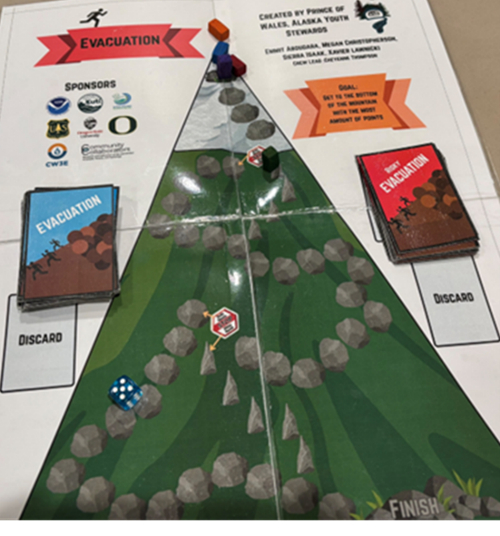
The original board game, “Evacuation,” developed by the Klawock Alaska Youth Stewards inspired by the Ḵutí project.
Credit for all images: Adelaide Johnson
From the Editor
Participatory Science for Community Landslide Awareness shows how community science can produce meaningful local impact. The project highlights the value of building trust, strengthening community relationships, and incorporating local knowledge to guide research priorities. That investment improved outcomes by deepening understanding of landslide risk and supporting development of a geohazard dashboard for the community. The approach and considerations employed in this study are instructive models for other communities looking to address needed scientific research.
—Kathryn Semmens, Deputy Editor
Project Team

About Us
The Community Science Exchange is a platform led by a coalition of partner societies, launched for elevating, sharing, and expanding the reach of science performed by, for, and with communities.